

GKV vs PKV, explained
We help you understand both systems clearly before you commit to either.
Whole-market comparison
We compare providers across the market, not just one insurer's products.
Support in English
Get help with paperwork and claims in plain English, whenever you need it.

Created with AI
What is private medical insurance for expats?
Health insurance is mandatory in Germany — every resident must be
covered, either through the public system (GKV) or a private insurer
(PKV). Which one suits you depends on your income, employment status
and long-term plans — not just your budget today.
JAEG 2026: €77,400/year — the income threshold above which employees
may choose private medical insurance (PKV) in Germany.
Compare GKV and PKV properly
Public and private health insurance differ in how contributions, benefits and family coverage work. We help you understand which system fits your situation.
Choose cover for the long term
The cheapest tariff today isn’t necessarily the best choice tomorrow. We compare benefits, costs and long-term flexibility before you decide.
Expats trust us for private medical insurance Germany advice
Real feedback from expats who finally understood their options — and
chose the cover that actually fits their life in Germany.


Super Nur gute Erfahrungen gemacht. Super Kundenservice. Netter Mensch und kompetente Beratung

Kompetente Beratung ohne Schnickschnack
Eigentlich hatte ich mir vorgenommen, hier ein lyrisches Meisterwerk als Rezession zu hinterlassen, aber mit Fakten ist man hier besser bedient 🙂 Das Thema Versicherungen war für mich immer eine Blackbox und ich habe es jahrelang vor mir hergeschoben, was natürlich auch nicht zielführend war. Chris konnte viel Licht in den dichten Versicherungsnebel bringen, hat mir alles super geduldig und ausführlich erklärt und mir die bestmöglichen Versicherungsoptionen angeboten. Kein Schnickschnack, kein unnötiger Quatsch. Super kompetent, prima Beratung und bei insure-Germany ist man einfach gut aufgehoben. Merci!
- § 34d GewO Licensed insurance broker
- IHK Registered in the German intermediary register
- Professional indemnity In place, as required by law
- GDPR-compliant Your data is never sold on
Created with AI
insure-Germany
Christian Keller · independent broker, Mannheim
- Independent advice
- GKV & PKV compared
Health insurance advice that actually protects your future
Health insurance in Germany isn’t optional, but choosing the right system isn’t always straightforward. The decision between GKV and PKV can have consequences that follow you for decades, especially as switching back from private to public health insurance becomes nearly impossible after age 55. That’s why independent advice matters: an independent broker should give you the whole picture and help you understand both options, rather than simply presenting one insurer’s pitch.
- Independent comparison across the whole market, not tied to one insurer
- Advice built around your income, career plans and life stage — not sales targets
- Ongoing support in English, including help with claims and paperwork
Confused by GKV vs PKV?
Get a clear, independent comparison before you commit to either
system — it costs you nothing.
Do expats need private medical insurance in Germany?
Health insurance is mandatory for everyone living in Germany, including
expats — there is no opting out. Most employees are covered through the
statutory system (GKV), but depending on income and employment status,
private medical insurance in Germany (PKV) may also be an option worth
considering.
The right choice depends on your income, family situation, age and
long-term plans, since switching between systems later is far more
restricted than choosing at the start. An independent broker can walk
you through both routes and help you weigh them before you commit.
Not mandatory
But widely considered essential
Few € / month
Typical entry-level pricing
High protection
For accidental third-party damage
German name
GKV (gesetzliche Krankenversicherung) — public; PKV (private Krankenversicherung) — private
Who it's for
GKV: most employees, pensioners, dependants; PKV: high earners, freelancers, self-employed, civil servants
Mandatory?
Yes — every resident must hold either GKV or PKV, without exception
Income threshold (JAEG)
JAEG €77,400/year (€6,450/month) in 2026 —employees above this may choose PKV; freelancers can choose regardless
Public option (GKV)
~17.5% of gross income (14.6% + avg 2.9% Zusatzbeitrag), split employer/employee, capped at Beitragsbemessungsgrenze €69,750/year
Private option (PKV)
Premiums set by age, health status and chosen benefits — not by income
Who should consider private medical insurance in Germany?
Not every expat has a free choice between GKV and PKV — eligibility depends on how you earn your income, how much you earn, and how long you plan to stay. Understanding where you fit is the first step before comparing private medical insurance in Germany against the public
alternative.
Employees earning above €77,400
Once your gross salary crosses the Jahresarbeitsentgeltgrenze (JAEG) of €77,400/year in 2026, you’re no longer required to stay in GKV —
private medical insurance in Germany becomes an option. This doesn’t mean PKV is automatically the better fit; it simply opens the door. The
decision should factor in age, health, family plans and how long you intend to stay in Germany, since reversing course later is difficult.
Freelancers and self-employed
Self-employed professionals and freelancers can choose PKV regardless of how much they earn, since the JAEG threshold only applies to
employees. This makes private medical insurance in Germany relevant even for those just starting out. Because PKV premiums depend on age
and health rather than income, getting advice before enrolling — while you’re younger and healthier — often shapes the premium you’ll pay for
years to come.
Expats arriving in Germany
New arrivals typically need proof of health cover within the first weeks of registering an address (Anmeldung), and sometimes before a visa is
even issued. Students face separate, usually lower-cost statutory options. Employees starting a new job are generally enrolled in GKV automatically unless they qualify for and actively choose PKV. Getting
this decision right early avoids a costly correction later.
A decision that shapes decades of cover
It's mandatory — and the choice has decades-long consequences
Health insurance isn't optional in Germany, and unlike a policy you can cancel freely, the GKV/PKV decision often locks you into a path for years, sometimes for life.
GKV vs PKV — two completely different systems
Public and private health insurance in Germany aren't variations of the same product. They run on different funding logic, different benefits, and different rules — comparing them properly takes more than a quick glance.
Switching back gets harder with age
Leaving PKV to rejoin GKV becomes practically impossible after age 55. A decision made in your thirties can quietly shape your options decades later.
GKV vs PKV — which system fits your situation?
There’s no universally “right” answer between GKV and PKV — the better
fit depends on your circumstances. Income matters because GKV
contributions rise with what you earn, while PKV premiums are fixed to
age and health at entry. Family situation matters too: GKV covers a
non-earning spouse and children for free (Familienversicherung), a
benefit PKV doesn’t replicate without separate premiums per person. Age
and health affect PKV pricing directly and determine how easily you
could switch later. Long-term plans — how long you intend to stay in
Germany, whether you expect income to fluctuate, and how much you value
benefits like private rooms or specialist access — all factor into
which system serves you better over time.
€77,400
The 2026 annual income threshold employees generally need to exceed before they can choose private health insurance (PKV).
What to consider before choosing
- Your current and expected future income
- Whether you're employed, self-employed or freelance
- Whether you have or plan to have dependants
- Your age and general health
- How long you plan to stay in Germany
- Whether GKV Familienversicherung would cover your family for free
- How much flexibility you want to keep for the future
- Whether faster specialist access or private rooms matter to you
Weighing these factors across providers is the actual work — and it’s what the free advice is for. As an independent broker, we’re paid via commission already included in the premium, so comparing GKV and PKV costs you nothing.
What both systems provide for you
Examples of everyday accidents typically covered by personal liability insurance in Germany.
- GKV & PKV
Full medical cover from day one in Germany
Both GKV and PKV provide comprehensive medical cover from the point your policy starts, meeting the mandatory insurance requirement for residents and visa applicants alike.
- SUPPORT
English-speaking doctor access and claims support
Many providers and brokers can point expats towards English-speaking doctors and specialists, and help navigate claims and paperwork that's often only available in German.
- GKV + PKV OPTIONS
Hospital, dental and specialist care
Core hospital treatment, GP visits, prescribed medication and basic dental care are covered under GKV; PKV can extend this with private rooms, chief physician treatment and broader specialist choice.
- GKV ONLY
Family members covered (GKV Familienversicherung)
Under GKV, a spouse or children earning under €538/month are insured alongside the main policyholder at no extra cost — a benefit unique to the public system.
Limits and exclusions worth understanding
Common exclusions worth understanding before you rely on a policy.
Dental extras beyond basic (in standard GKV)
Standard GKV covers essential dental treatment, but crowns, implants and higher-grade materials typically require supplementary cover or come with significant out-of-pocket cost.
Travel insurance outside Europe
Both GKV and PKV are designed for treatment within Germany and, to varying degrees, the EU. Neither substitutes for dedicated travel insurance when travelling further afield.
Pre-existing condition exclusions (some PKV)
PKV providers can exclude or surcharge for pre-existing conditions identified during underwriting — something GKV, with no health check on entry, does not do.
Elective treatments and alternative medicine (varies)
Cosmetic procedures, some alternative therapies and certain elective treatments sit outside standard cover in both systems, though PKV tariffs vary considerably on what's included.
What’s covered depends on the insurer and tariff — we compare the details and exclusions to find cover that fits your needs.
GKV vs PKV — a clear comparison
Two systems, not two versions of the same thing. Here’s how they
actually differ.
Private health insurance (PKV)
Open to the self-employed and higher earners
Who can choose it
- Faster specialist appointments and a wider choice of doctors and clinics
- You choose the level of cover, from lean and cheap to comprehensive
- Premiums are based on age and health at entry — often lower while you're young
- Your benefits are fixed by contract and can't be cut by a change in the law
- Every family member is insured — and paid for — separately
- Health questions at application; pre-existing conditions affect the premium
- Moving back to public cover is heavily restricted once you're over 55
- Premiums rise with age and medical costs, not with your income
Public health insurance (GKV)
The default route for most employees
Who can choose it
Employees earning under the annual threshold, students, and most pensioners – for many people this isn’t a choice, it’s automatic.
- Contributions scale with your income, never with your health
- A non-earning spouse and your children are usually covered at no extra cost
- No health questions, no risk assessment — pre-existing conditions don't block you
- You can still move to private later if you become eligibl
- Standard care, with noticeably longer waits for some specialists
- Your contribution rises automatically as your salary rises
- Moving back to public cover is heavily restricted once you're over 55
- Little room to tailor the cover — benefits are set by law, not by you
Neither system is objectively better — it depends entirely on your situation. On a free call, we compare both for your specific income, family and plans.
How health insurance in Germany actually works
The practical details behind the system — kept short. Open only what’s relevant to you.
How does the German health insurance system work?
Germany runs a dual system: the statutory GKV, funded through income-
based contributions and covering the majority of residents, and the
private PKV, available to eligible groups and priced by age and health. Both are mandatory routes to compulsory cover — there’s no third, uninsured option, and every resident must be enrolled in one or the
other.
What is the JAEG and why does it matter?
The Jahresarbeitsentgeltgrenze (JAEG) is the annual income threshold —
€77,400 in 2026 — above which employees may leave GKV and choose
private medical insurance in Germany instead. Below it, employees generally stay in the public system by default. Freelancers and the self-employed aren’t bound by this threshold and can choose PKV at any income level.
What are Alterungsrückstellungen (age reserves) in PKV?
PKV insurers build Alterungsrückstellungen — age reserves — from your premiums while you’re younger, specifically to offset the higher healthcare costs expected as you age. This is designed to keep premiums
from rising sharply later in life. It’s a core structural difference
from GKV, where contributions are recalculated each year against current
income rather than pre-funded.
Can I switch back from private to public health insurance?
In principle, yes, but in practice it becomes very difficult after
age 55, and is restricted well before that too — typically requiring a qualifying life event such as dropping below the JAEG or losing self-employed status. Because reversing the decision is so constrained,
the initial choice between GKV and PKV deserves careful, unhurried consideration.
What happens to my health insurance if I leave Germany?
Neither GKV nor PKV automatically continues to provide full cover once you permanently leave Germany, though rules and any refund of PKV reserves vary by provider and circumstance. If you’re relocating, it’s worth reviewing your policy terms and portability options well before
departure, ideally with independent advice.
Is health insurance advice from a broker really free?
Is health insurance advice from a broker really free? Yes. As an independent broker under §34d GewO, Christian Keller is paid by commission from the insurer once a policy is arranged, not by the
client. This means comparing GKV and PKV options, or reviewing existing cover, comes at no direct cost to you.
Advice that's on your side, not the insurer's
Three different policies that expats often mix up. Here’s what each one actually does.
Insurers compared
Whole-of-market view instead of a single product line — we compare cover and conditions, not just price.
Licensed broker
Registered insurance broker under § 34d GewO — legally your representative, not the insurer's salesperson.
Advice is free
Brokers are paid via commission already included in the premium. Your policy costs the same, with or without us.
English-speaking support
Setup, documents and claims handled in English or German — whichever is easier for you.
Named contact
One person who knows your file — from the first call through to a claim years later.
Clients advised
Insert your real figure once available — a verified client count builds strong trust here.
Health insurance in Germany — FAQ
Is health insurance mandatory in Germany?
Yes. Every resident of Germany, including expats, must hold health
insurance — either statutory (GKV) or private (PKV). Proof of cover is
typically required when registering your address or applying for a visa,
and there is no legal way to remain uninsured.
What's the difference between GKV and PKV?
GKV is income-based and covers a non-earning spouse and children for
free; PKV is priced by age and health, with no automatic family cover.
Both provide comprehensive medical treatment, but the underlying funding
logic and long-term flexibility differ substantially.
How much does public health insurance cost in 2026?
GKV contributions total roughly 17.5% of gross income — 14.6% plus
an average 2.9% Zusatzbeitrag — split between employer and employee,
and capped at a Beitragsbemessungsgrenze of €69,750/year. The exact rate
can vary slightly by insurer.
Can my family be covered under my public health insurance?
Yes, under GKV’s Familienversicherung, a spouse or children earning
under €538/month can be insured alongside you at no additional cost.
This family cover does not exist in the same form under PKV, where each
person needs their own premium.
Is private health insurance cheaper than public?
Short stays still require valid health insurance, and the right
option depends on your visa type, employment status and length of stay.
Students and short-term assignees often have separate, lower-cost
statutory routes worth checking before committing to a longer-term
policy.
What if I'm only in Germany for a short time?
No. A private policy only covers private matters. Work- or business-related risks need professional or business liability cover. If you freelance, take a look at our business insurance for freelancers page.
Do I pay you for health insurance advice?
No. Christian Keller works as an independent broker under §34d GewO
and is remunerated by commission from the insurer once cover is
arranged, so advice and comparison between GKV and PKV options cost you
nothing directly.
Cover expats often sort out alongside
Image created with AI
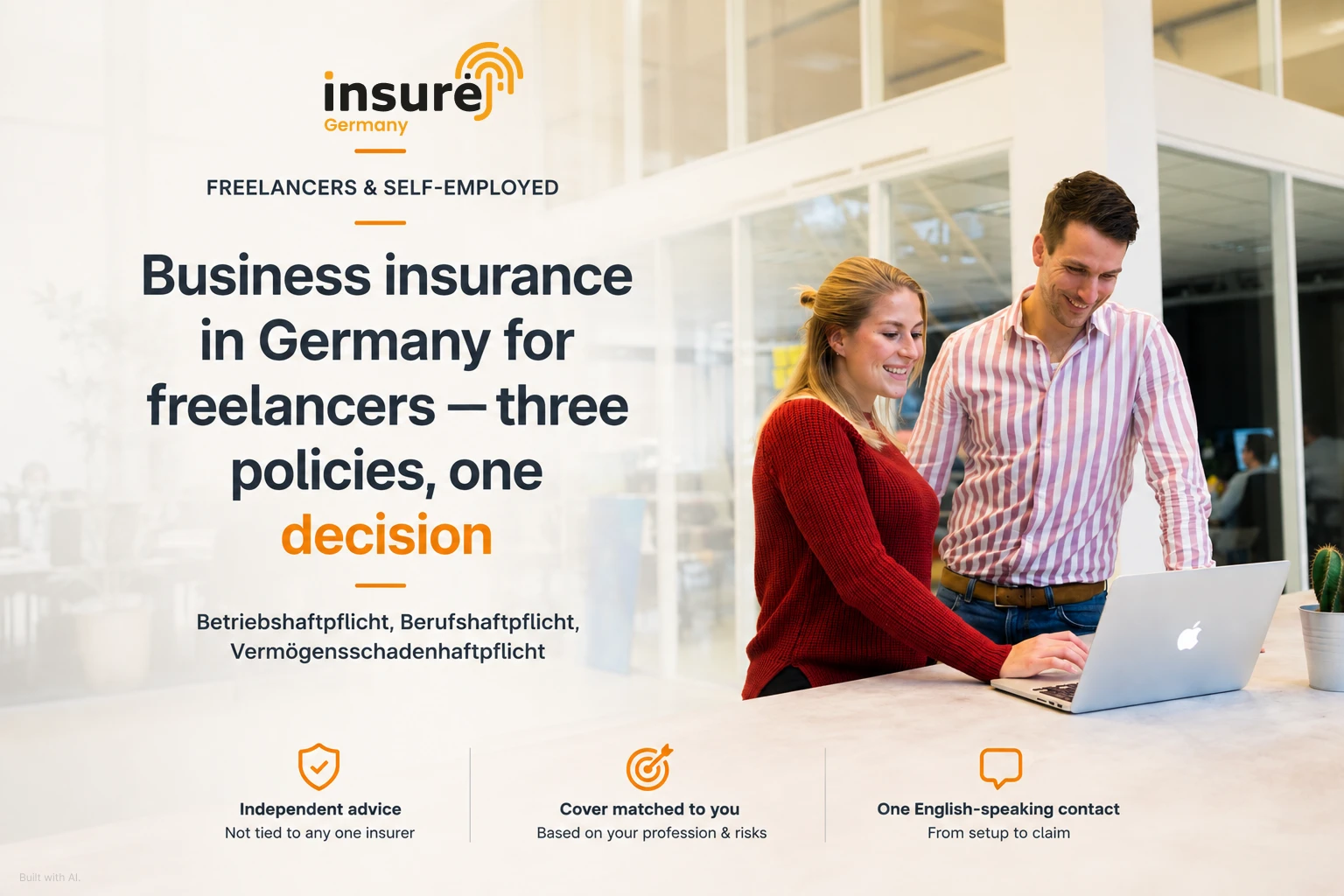
Business Insurance →
Protect your business against the risks that come with running a company in Germany.

Pet health insurance →
Covers vet bills, treatment and surgery — depending on the level of cover.

Health insurance for expats →
Public vs private, explained - and set up in English.

Private pension →
Build long-term retirement savings in Germany with a plan that fits your life and goals.

Legal insurance →
Get financial protection for legal disputes involving work, housing, traffic or everyday life in Germany.

Personal liability →
Protect yourself from costly claims if you accidentally injure someone or damage their property.

Get your health cover sorted — the right way
Book a free 30-minute call and get an independent, English-language
comparison of GKV and PKV — matched to your income, your family and
how long you plan to stay in Germany.