

Vertraut von 100+ Expats
in ganz Deutschland
Ungebundene Beratung für Expats
Legal insurance in Germany — independent, English-speaking advice
Erstellt mit KI
Rechtsschutz, plainly explained
We translate the German small print — waiting periods, deductibles and modules — into decisions you can actually make.
Marktweiter Vergleich
We compare providers across the market, not just one insurer's tariff or the two apps everyone recommends.
Unterstützung auf Englisch
Setup, module choices and claims handling — walked through in English, whenever you need it.

Erstellt mit KI
What legal insurance covers in Germany
Lawyer and court fees in Germany can escalate quickly — a single employment or tenancy dispute can cost several thousand euros before anyone reaches a verdict. Legal insurance in Germany (Rechtsschutzversicherung) pays those costs when a covered dispute arises, and lets you pick your own lawyer — including an English-speaking one.
Standard 3-month waiting period
Most disputes that existed before your policy started are excluded — timing of sign-up matters more than the price.
Modules chosen for your life
Tenant, employment, traffic, contract — the right module set matters more than the biggest package.
Expats trust us for legal insurance germany advice they can act on
Real feedback from expats who finally understood what their policy would — and wouldn’t — pay for, before signing anything.


Super. Nur gute Erfahrungen gemacht. Super Kundenservice. Netter Mensch und kompetente Beratung

Kompetente Beratung ohne Schnickschnack
Eigentlich hatte ich mir vorgenommen, hier ein lyrisches Meisterwerk als Rezession zu hinterlassen, aber mit Fakten ist man hier besser bedient Das Thema Versicherungen war für mich immer eine Blackbox und ich habe es jahrelang vor mir hergeschoben, was natürlich auch nicht zielführend war. Chris konnte viel Licht in den dichten Versicherungsnebel bringen, hat mir alles super geduldig und ausführlich erklärt und mir die bestmöglichen Versicherungsoptionen angeboten. Kein Schnickschnack, kein unnötiger Quatsch. Super kompetent, prima Beratung und bei insure-Germany ist man einfach gut aufgehoben. Merci!
- § 34d GewO Zugelassener Versicherungsmakler
- IHK-registriert im Vermittlerregister
- Berufshaftpflicht wie gesetzlich vorgeschrieben abgeschlossen
- DSGVO-konform — Ihre Daten werden nicht weiterverkauft
Erstellt mit KI
insure-Germany
Christian Keller · ungebundener Versicherungsmakler, Mannheim
- Ungebundene Beratung
- Modules compared
Legal cover that pays when you actually need it
Rechtsschutzversicherung isn’t one product — it’s a stack of modules with different waiting periods and exclusions. The cheapest tariff is almost never the one that pays out when the dispute you actually have arrives.
Pre-existing disputes are excluded — timing your policy right costs nothing but saves everything. An independent broker owes you the whole picture, not just one insurer’s app.
- Independent comparison across the whole market — not tied to a single provider or app
- Advice built around the disputes you're actually exposed to — tenant, employment, traffic, contract
- Ongoing support in English, including help when a claim comes up
Not sure which modules you actually need?
Get a clear, independent walkthrough of tenant, employment, traffic and contract cover — before you commit to a policy. No pressure, no cost.
Do expats really need legal insurance in Germany?
Legal insurance is not mandatory in Germany, but for most expats it’s one of the more useful policies to hold. Lawyer fees under German law follow a fixed statutory schedule (RVG) that scales with the amount in dispute, so even routine cases can run into four figures. Rechtsschutzversicherung covers those costs — plus court fees, expert opinions and, in most tariffs, mediation.
The catch is timing: standard policies have a 3-month waiting period, and any dispute that had already started before you signed up is excluded. That’s why the question isn’t only ‘do I need it’ but ‘when should I have set it up’ — usually the answer is ‘before the situation that made you ask.’
Nicht Pflicht
But strongly recommended in Germany
Modular cover
Tenant, employment, traffic, contract — pick yours
Free lawyer choice
You pick your own — including English-speaking
Deutscher Name
Rechtsschutzversicherung (also Rechtsschutz)
Für wen
Anyone exposed to disputes — tenants, employees, drivers, freelancers
Pflicht?
No — but strongly recommended given German legal cost scales
Waiting period
Typically 3 months (Wartezeit); traffic module often exempt
Deductible
Common range €150–€300 per case (Selbstbeteiligung)
Modules available
Privat, Beruf, Verkehr, Miet-/Wohnung, Vertrag
Who should consider legal insurance in Germany?
Not everyone needs the same modules — and some situations make legal insurance in germany far more urgent than others. Understanding your actual exposure comes before comparing tariffs. Open a group below to see who benefits most:
Tenants and renters
Tenancy disputes are the single most common reason expats end up in front of a German court — over deposits, service-charge invoices (Nebenkostenabrechnung), rent increases, or termination notices. Miet-/Wohnungsrechtsschutz is the module that covers these, and it’s often sold separately from the base policy. If you rent, this is usually the first module worth having; if you also let out a property, different rules and premiums apply.
Employees and freelancers
Arbeitsrechtsschutz (employment legal cover) is relevant for anyone in a German employment contract — from disputes over dismissal notices and severance to unpaid overtime or reference letters (Arbeitszeugnis). Freelancer face a different exposure: contract disputes with clients, which fall under Vertragsrechtsschutz rather than employment cover. Getting the right module matters more than buying the biggest package.
Expats, die neu in Deutschland ankommen
Verkehrsrechtsschutz (traffic legal cover) covers disputes arising from driving — accidents where fault is contested, licence issues, fines you want to challenge, and criminal charges arising from driving. It’s often the cheapest module and, unusually, sometimes comes without a waiting period — which makes it worth sorting before you actually need it.
Why legal cover isn't optional in practice
German lawyer fees scale with the dispute value
Lawyer fees in Germany follow a statutory schedule (RVG) that scales with the amount in dispute. A modest tenancy or employment case can easily cost four figures in fees before a verdict is reached.
You lose, you often pay both sides
In many German civil proceedings, the losing party pays their own costs AND the opponent's. Without cover, an unsuccessful claim can cost multiples of what you thought was at stake.
The clock starts before the fight does
Standard policies exclude disputes that already existed at sign-up and impose a 3-month waiting period. Buying cover when trouble appears is usually too late — the value comes from having it early.
Which modules and which tariff — the real questions
Choosing legal insurance in germany isn’t about finding the cheapest policy — it’s about matching modules and terms to your actual risks. Renting an apartment? You need Miet-/Wohnungsrechtsschutz. In a German employment contract? Arbeitsrechtsschutz. Driving? Verkehr. Freelancing with clients? Vertragsrechtsschutz. The wrong module set means you pay premiums for years and are still uncovered for the one dispute that arrives. Beyond scope, three things quietly decide whether a policy pays out: waiting period, deductible level and how strictly the insurer defines ‘pre-existing dispute.’
3 months
The standard Wartezeit — during which most claims aren’t paid. Traffic module often exempt. This is why timing your sign-up matters more than shaving a few euros off the premium.
What to check before signing
The details that separate two policies at a similar price:
- Modules matched to your exposure (tenant, employment, traffic, contract)
- Waiting period — 3 months standard, sometimes shorter for traffic
- Deductible you can live with (€0 costs more; €300 is common)
- Coverage limit per case and per year
- Geographic scope (Germany, EU, worldwide)
- Mediation cover included
- How the insurer defines a "pre-existing dispute"
- Free choice of lawyer without friction
Comparing these details across insurers is the actual work — and it’s what the free advice is for. As an independent broker we’re paid via commission already included in the premium, so getting Rechtsschutzversicherung right costs you nothing.
What legal insurance typically pays for
The core costs a Rechtsschutz policy takes off your plate when a covered dispute arises.
- Abgedeckt
Lawyer fees under the statutory schedule
Fees according to the German Rechtsanwaltsvergütungsgesetz (RVG) — across consultations, out-of-court correspondence and litigation.
- Abgedeckt
Court costs and expert opinions
Court filing fees, judicial costs and fees for court-appointed experts (Sachverständige), which often outweigh lawyer costs in technical disputes.
- Abgedeckt
Opponent's costs if you lose
In German civil proceedings the losing side typically bears the winner's costs. Legal insurance covers this exposure within the sum insured.
- Abgedeckt
Mediation and translation (tariff-dependent)
Many modern tariffs include out-of-court mediation and, increasingly, translation services for expats — often more useful than going to court.
Grenzen und Ausschlüsse, die Sie kennen sollten
Common exclusions worth knowing before you rely on a Rechtsschutz policy.
Pre-existing disputes
Any dispute that already existed before you signed the policy is excluded — this is the single most common reason claims are rejected.
Waiting period cases
Most claims arising in the first 3 months of the policy aren't covered. The traffic module is sometimes an exception.
Intentional acts and grossly wrongful conduct
Cases where the insured party acted deliberately unlawfully are excluded across essentially all providers.
Certain business and construction disputes
Standard private tariffs exclude business/commercial disputes and construction-related claims (Baurechtsschutz), which need dedicated cover.
Exact inclusions and limits vary by insurer and tariff. Part of the free advice is checking the wording against the disputes you’re actually exposed to.
Legal vs personal liability vs household — what covers what
Three policies expats often mix up — personal liability, household contents, and legal cover. Here’s what each one actually does — and why many households eventually hold all three.

Legal (Rechtsschutz)
Household contents (Hausrat)
Protects
Your legal costs in a dispute
Other people and their property from damage you cause
Your own belongings at home
Typischer Schadenfall
A conflict with a landlord or employer
You flood the neighbour’s flat
Your laptop is stolen in a burglary
Who should have it
Renters, employees, drivers, freelancers
Practically everyone in Germany
Anyone with valuables worth replacing
Pflicht?
No, but widely recommended
No, but widely expected by landlords
Nein
Mehr erfahren
This page
Household
Many expats end up holding all three within their first years in Germany. On a free call we work out which you actually need — and which you can skip.
How legal insurance in Germany actually works
The practical details behind the product — kept short. Open only what’s relevant to you.
How does Rechtsschutzversicherung work in practice?
When a covered dispute arises, you contact the insurer for a Deckungszusage (confirmation of cover). Once confirmed, you can instruct any licensed lawyer of your choice — the insurer settles their fees according to the Rechtsanwaltsvergütungsgesetz (RVG), plus court costs and, if you lose, the opponent’s costs, up to your sum insured and minus any deductible. The insurer does not represent you; they fund the process.
What is the waiting period (Wartezeit)?
Most modules have a 3-month waiting period from the policy start date, during which claims are generally not covered. Traffic (Verkehr) and sometimes criminal defence are commonly exempt. The waiting period is why last-minute sign-up rarely helps and why new residents are usually advised to arrange cover early.
What counts as a pre-existing dispute?
Insurers exclude disputes whose triggering event (Rechtsschutzfall) occurred before the policy started. What counts as the triggering event varies by provider and can become the crux of a claim — some insurers use narrow, expat-friendly definitions; others read them broadly. Independent comparison is where this actually matters.
Can I choose my own lawyer?
Yes — free choice of lawyer (freie Anwaltswahl) is protected under German law, and applies to legal insurance too. You can select any licensed lawyer, including an English-speaking one. The insurer cannot force you to use a specific firm, though they may suggest options.
How does the deductible (Selbstbeteiligung) work?
The deductible (Selbstbeteiligung) is what you pay per case before the insurer covers the rest. Common ranges are €150–€300; some tariffs offer €0 at higher premiums, and others offer discounts for claim-free years. The right level depends on how you’d rather balance monthly premium against occasional out-of-pocket cost.
Is legal insurance advice from a broker really free?
Ja. Als ungebundener Makler nach §34d GewO, Christian Keller is paid by commission from the insurer once a policy is arranged, not by the client. Comparing tariffs, or reviewing existing cover, comes at no direct cost to you.
Advice that works for you, not for the insurer
What an independent broker actually does — kept in numbers.
Verglichene Anbieter
Whole-of-market view of Rechtsschutz providers — we compare tariff wording, waiting-period exceptions and module scope, not just prices.
Zugelassener Makler
Registrierter Versicherungsmakler nach §34d GewO — rechtlich Ihr Vertreter, nicht der Verkäufer des Versicherers.
Beratung ist kostenlos
Makler werden über die Courtage vergütet, die ohnehin im Beitrag enthalten ist. Ihre Absicherung kostet dasselbe, mit oder ohne uns.
Unterstützung auf Englisch
Setup, module choices, documents and claims handled in English or German — whichever is easier for you.
Persönlicher Ansprechpartner
One person who knows your file — from choosing the modules through to a claim years later.
Beratene Kunden
Fügen Sie Ihre echte Zahl ein, sobald verfügbar — eine verifizierte Kundenzahl schafft hier starkes Vertrauen.
Legal insurance in Germany — FAQ
Is legal insurance mandatory in Germany?
No, Rechtsschutzversicherung is not required by law. It is, however, one of the most widely recommended policies for residents, because German lawyer and court fees scale with the amount in dispute and can quickly reach four figures even for routine tenancy or employment cases.
What does legal insurance cover in Germany?
Standard modules cover tenant, employment, traffic and contract disputes — including lawyer fees under the RVG schedule, court costs, expert opinions and, if you lose, the opponent’s costs up to your sum insured. Modules are chosen individually, so cover matches your actual situation.
Is there a waiting period for legal insurance?
Yes, typically 3 months (Wartezeit) from the policy start date. The traffic module and criminal defence cover are sometimes exempt. Any dispute whose triggering event occurred before sign-up is excluded as pre-existing.
Can I pick an English-speaking lawyer?
Yes. Free choice of lawyer (freie Anwaltswahl) is protected under German law and applies to legal insurance too. You can appoint any licensed lawyer, including one who works in English — the insurer cannot force you to use their preferred firm.
How much is the deductible?
Common deductibles range from €150 to €300 per case, though tariffs with €0 deductible or claim-free discounts exist at higher premiums. The right level is a personal trade-off between monthly cost and occasional out-of-pocket exposure.
Does legal insurance cover disputes that already started?
No. Insurers exclude disputes whose triggering event occurred before the policy started, and the exact definition of that trigger varies between providers. This is where independent comparison matters most.
Do I pay you for legal insurance advice?
Nein. Christian Keller arbeitet als ungebundener Versicherungsmakler nach §34d GewO and is paid by commission from the insurer once cover is arranged, so comparing legal insurance in germany across providers costs you nothing directly.
Absicherung, die Expats häufig gleich mit klären neben
Bild erstellt mit KI
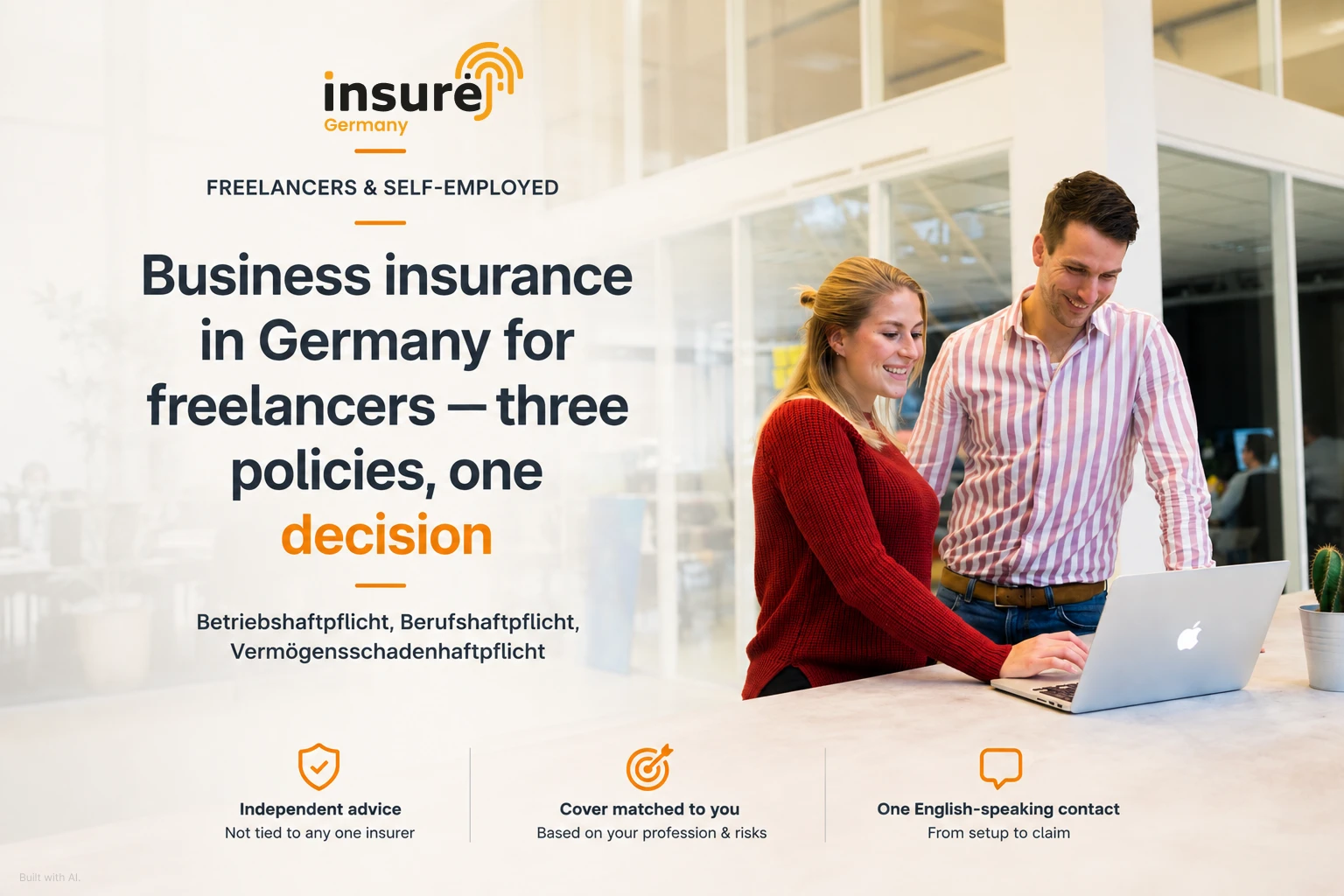
Business-Versicherung →
Schützen Sie Ihr Unternehmen vor den Risiken, die mit einer Unternehmensführung in Deutschland einhergehen.

Tierkrankenversicherung →
Deckt Tierarztkosten, Behandlung und Operationen ab — je nach gewähltem Versicherungsumfang.

Krankenversicherung für Expats →
Gesetzlich vs. privat, erklärt — und auf Englisch eingerichtet.

Private Altersvorsorge →
Bauen Sie sich eine langfristige Altersvorsorge in Deutschland auf — mit einem Plan, der zu Ihrem Leben und Ihren Zielen passt.

Rechtsschutzversicherung →
Erhalten Sie finanziellen Schutz bei Rechtsstreitigkeiten rund um Arbeit, Wohnen, Verkehr oder den Alltag in Deutschland.

Privathaftpflicht →
Schützen Sie sich vor teuren Forderungen, falls Sie versehentlich jemanden verletzen oder fremdes Eigentum beschädigen.

Get legal cover sorted — before you need it
Book a free 30-minute call and get an independent, English-language walkthrough of the modules, waiting periods and pre-existing definitions that actually decide whether your policy pays out.